

Moisture Analyzer Market Growth Advances Toward USD 3.37 Billion with 5.4% CAGR
Moisture Analyzer Market
Moisture Analyzer Market Size, Share and Research Report By Analyzing Technique (Loss-On-Drying, Near-Infrared, Karl Fischer Titration, Microwave/RF, Others)
Moisture Analyzer Market: Growing steadily due to stringent quality control standards requiring precise moisture content measurement across food, pharmaceutical, and chemical manufacturing.”
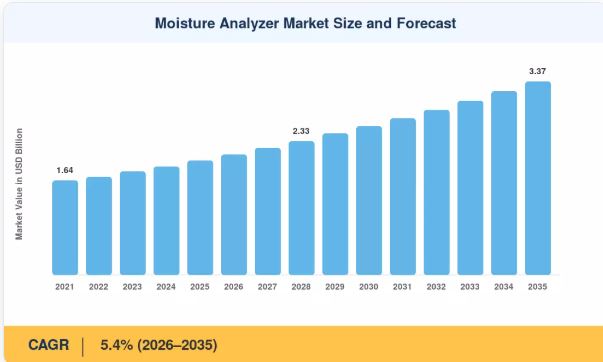
NEW YORK,, NY, UNITED STATES, September 3, 2026 /EINPresswire.com/ -- The Global Moisture Analyzer market closed 2025 at USD 1.99 billion and opens the forecast window at USD 2.10 billion in 2026, climbing to USD 3.37 billion by 2035 at a 5.4% CAGR. Two catalysts anchor that trajectory. The FDA's Food Safety Modernization Act preventive-controls rule pushed water-content verification from a quality nicety into a documented compliance step for roughly 78,000 registered facilities, and the EU's revised GMP Annex 1, effective August 2023, tightened residual-moisture evidence requirements for sterile drug manufacturing. — Market Research Future (MRFR)
The market's 5.4% CAGR reflects the convergence of food safety compliance mandates (1.3% impact), pharmaceutical GMP tightening (1.1%), the shift to rapid halogen drying (0.9%), and process line integration of sensors (0.8%) accelerating across the world's largest regulated-manufacturing and food-safety economies simultaneously.
A moisture analyzer is an analytical instrument designed to determine the amount of moisture present in a material or sample. Depending on the technology, these systems can measure moisture using techniques such as loss-on-drying, Karl Fischer titration, infrared, microwave, capacitance, near-infrared, and radio-frequency analysis.
The importance of moisture measurement extends across the production cycle. Excessive or insufficient moisture can influence product weight, texture, shelf life, stability, processing efficiency, and material performance. As manufacturers move toward automated and data-driven quality control, moisture analysis is increasingly shifting from laboratory testing toward real-time and in-line monitoring.
Get Full PDF Sample Copy of Report: (Including Full TOC, List of Tables & Figures, Chart) @
https://www.marketresearchfuture.com/sample_request/7440
➤ Moisture Analyzer Market Future Outlook:
The future of the Moisture Analyzer Market will be shaped by the convergence of precision measurement, automation, sensors, AI, IoT, and real-time analytics. The industry is gradually moving beyond simple laboratory moisture testing toward connected systems capable of supporting continuous process monitoring and automated quality control. In-line sensors, portable instruments, near-infrared technologies, and smart laboratory systems are expected to create new opportunities across manufacturing and field applications.
As manufacturers place greater emphasis on reducing waste, improving production efficiency, and maintaining consistent product quality, accurate moisture measurement will remain an important part of modern industrial quality-control systems.
➤ What Does the Future Hold for the Moisture Analyzer Market?
Food safety compliance mandates contribute approximately 1.3 percentage points to the moisture analyzer market's CAGR the single highest driver impact. Regulators have made water content an auditable parameter rather than an internal statistic. Water activity thresholds are central to shelf-stability arguments for low-moisture foods, and FSMA preventive-controls regulations require covered establishments to record hazard controls.
Approximately 1,900 preventive-controls findings were documented in FDA inspection data covering fiscal 2023, a significant portion linked to insufficient parameter verification. In response, facilities installed specialized per-line ovens in place of communal bench ovens.
Pharmaceutical GMP tightening contributes approximately 1.1 percentage points to the CAGR, establishing sterile-manufacturing compliance as a primary structural driver. Since Annex 1 went into effect, the burden of proof for sterile manufacturers has increased, with inspectors increasingly demanding method-comparability data across titration and drying procedures, and residual water in lyophilized product must be shown to be within defined limits. Between 2021 and 2024, EMA released 312 GMP non-compliance statements, among which analytical method deficiencies were a recurrent category, redirecting capital toward compliant equipment.
The shift to rapid halogen drying adds a further 0.9% as a halogen bench unit returns a result in under twelve minutes against three to four hours for oven reference methods, and laboratories running 60 samples daily recover instrument cost within roughly fourteen months on labour savings alone.
Process line integration of sensors contributes a further 0.8% as manufacturers no longer accept results that arrive after a batch has moved downstream, with in-line near-infrared heads feeding continuous readings into control loops and a 2024 pulp-and-paper deployment study across eleven European mills reporting energy savings of 6% to 9% in the drying section after closed-loop control was commissioned.
The next phase of the market's evolution centers on chemometric model automation, as machine-learning calibration strips the specialist bottleneck out of near-infrared deployment; models that once needed a spectroscopist and 80 reference samples now self-tune from 20, and vendors shipping cloud-hosted model management alongside hardware are expected to widen the addressable base into mid-sized processors by 2029.
Servitization of instrument fleets is also displacing capital purchase, with analytical instrument vendors reporting recurring revenue rising toward 40% of total sales across 2023 and 2024 filings, and moisture instrumentation following that pattern with bundled calibration, reagents, and compliance reporting.
Energy efficiency in industrial drying will keep in-line instrumentation growing faster than bench hardware, since drying consumes an estimated 10% to 15% of industrial energy use in developed economies and control precision translates directly into fuel reduction. Traceability and digital compliance are converging on electronic records with full audit trails, and instruments unable to produce tamper-evident data will fail inspection regardless of measurement accuracy, forcing a compliance-driven refresh across the market between 2027 and 2032.
Get access to the full description of the report @
https://www.marketresearchfuture.com/reports/moisture-analyzer-market-7440
➤ Who Are the Key Players in the Moisture Analyzer Market?
Concentration in the moisture analyzer market is moderate. The estimated Herfindahl-Hirschman Index sits near 950, with the top five suppliers holding roughly 44% of global revenue and a long tail of regional specialists serving grain, textile, and construction niches. Precision-balance heritage confers real advantage at the bench, while process instrumentation is contested by automation vendors entering from the control-systems side. MRFR identifies the following key participants:
• Mettler-Toledo International
• Sartorius AG
• Metrohm AG
• Shimadzu Corporation
• A&D Company
• Thermo Fisher Scientific
• CEM Corporation
• Kett Electric Laboratory
• AMETEK Process Instruments
• Bruker Corporation
Strategic competition in the moisture analyzer market is increasingly defined by electronic-records compliance and chemometric model management rather than raw measurement accuracy alone, with high capital cost of titration systems cited as a top structural headwind, contributing an estimated -0.8% drag on CAGR as coulometric titration systems with autosamplers routinely list above USD 22,000 before service contracts, a figure that stalls procurement at contract laboratories operating on thin per-test margins, alongside long replacement cycles for bench units that typically last eleven to fourteen years, method validation burden that consumes six to ten weeks of analyst time, skilled operator scarcity in South America and MEA, and reagent supply and disposal costs.
➤ What Are the Emerging Trends in the Moisture Analyzer Market?
Several transformational trends are redefining the moisture analyzer market's evolution through 2035:
Continuous Process Analytics: Real-time water-content measurements are required during the granulation and drying phases of pharmaceutical continuous manufacturing lines operating under the FDA's PAT framework, with vendors who package probes with chemometric model libraries able to charge service fees significantly higher than the hardware margin.
Battery Electrode Qualification: Lithium-ion electrode coatings tolerate only parts-per-million water before cell performance deteriorates, and with planned gigafactory capacity in North America and Europe exceeding 1,400 GWh through 2030, each line needs specific trace-water instrumentation.
Emerging-Market Grain Infrastructure: Brazilian and Indian grain storage expansion is creating demand for ruggedized handheld units at the elevator and cooperative level, with India's post-harvest infrastructure fund having committed roughly USD 1.1 billion toward storage modernization, quality-testing equipment an eligible expense.
Instrument Data Monetization: Connected analyzers generate calibration, drift, and method-usage telemetry, and vendors are packaging this into subscription compliance dashboards that auto-generate audit-ready records, converting one-time hardware sales into recurring annual contracts of USD 1,200 to USD 3,500 per instrument.
Contract Testing Laboratory Expansion: Outsourced analytical testing continues absorbing volume from in-house quality units, and high-throughput laboratories buy in fleets rather than singles, reinforcing demand for compendially validated, high-uptime instrumentation.
Buy Full Research Report:
https://www.marketresearchfuture.com/checkout?currency=one_user-USD&report_id=7440
➤ How Is the Moisture Analyzer Market Segmented?
The moisture analyzer market report provides a comprehensive segmentation framework:
By Analyzing Technique: Loss-On-Drying (41.6% share), Near-Infrared (7.4% CAGR), Karl Fischer Titration (USD 0.42 billion), Microwave/RF (9.1% share), Others (6.3% share)
By Equipment Type: Benchtop (56.8% share), Handheld/Portable (6.2% CAGR), In-line/On-line Sensors (USD 0.38 billion)
By End-Use Industry: Food and Beverage (36.8% share), Pharmaceuticals and Biotechnology (6.8% CAGR), Chemicals and Petrochemicals (USD 0.31 billion), Agriculture and Feed (12.4% share), Pulp and Paper (7.9% share), Others (5.2% share)
By Component: Moisture Analyzer Instrument (68.2% share), Sensors and Probes (6.9% CAGR), Consumables (USD 0.19 billion)
By Region: North America (34.2% share), Europe (USD 0.56 billion), Asia-Pacific (7.1% CAGR), South America (USD 0.12 billion), Middle East & Africa (4.7% share)
➤ What Are the Regional Insights from the Moisture Analyzer Market?
American demand in the moisture analyzer market concentrates in New Jersey, North Carolina, and Indiana pharmaceutical corridors, where consent-decree remediation programs have forced analytical fleet refreshes, giving North America a 34.2% global share in 2025.
European buying decisions in the moisture analyzer market, which held a USD 0.56 billion base in 2025, increasingly hinge on energy cost.
Germany contributed USD 0.14 billion through chemical and pharmaceutical QC density, the United Kingdom holds 15.8% of regional share through post-Brexit MHRA testing duplication, France holds 13.2% of regional share through dairy and specialty food processing, Italy holds 10.4% of regional share through its generic drug manufacturing base, Spain holds 8.1% of regional share through olive oil and cured meat standards, the Nordic countries hold 7.6% of regional share through pulp and paper mill automation, Russia holds 5.2% of regional share through domestic grain export grading, and the rest of Europe holds 14.7% of regional share through contract manufacturing growth. Nordic mills adopting closed-loop drying control cite electricity savings rather than quality gains as the payback argument, a reframing that has moved sensor purchases from quality budgets into operations budgets.
India's revised Schedule M requirements, with compliance deadlines phased through 2025 and 2026, obligate several thousand small and mid-sized formulation units to upgrade quality-control laboratories, contributing to India's 8.4% CAGR within Asia-Pacific, the fastest-growing region overall in the moisture analyzer market at a 7.1% CAGR.
Brazilian commodity trading contracts settle on moisture-adjusted weight, making handheld accuracy a direct revenue matter for cooperatives, and Brazil commands 58.3% of South American regional share in the moisture analyzer market.
CONAB grading standards revisions have progressively narrowed acceptable measurement tolerance, pushing replacement of older capacitance meters, while Argentina holds 21.7% of regional share through grain elevator modernization and the rest of South America holds 20.0% of regional share through aquaculture and protein processing.
Gulf diversification programs have funded new petrochemical and specialty chemical laboratories in the Middle East & Africa, which held a 4.7% global share in 2025, where trace water determination in solvents and feedstocks is routine. Saudi Arabia commands 29.4% of regional share through petrochemical laboratory expansion, the UAE holds 22.1% of regional share through food import inspection infrastructure, South Africa holds 18.6% of regional share through mining and agricultural processing, Egypt holds 12.3% of regional share as wheat procurement volumes make grading instrumentation a food-security expenditure rather than a discretionary one, and the rest of MEA holds 17.6% of regional share through pharmaceutical localization programs.
➤➤➤ Regional & Country-Level Reports by Market Research Future:
US Moisture Analyzer Market -
https://www.marketresearchfuture.com/reports/us-moisture-analyzer-market-13524
Canada Moisture Analyzer Market -
https://www.marketresearchfuture.com/reports/canada-moisture-analyzer-market-57306
Europe Moisture Analyzer Market -
https://www.marketresearchfuture.com/reports/europe-moisture-analyzer-market-57307
Germany Moisture Analyzer Market -
https://www.marketresearchfuture.com/reports/germany-moisture-analyzer-market-46818
South Korea Moisture Analyzer Market -
https://www.marketresearchfuture.com/reports/south-korea-moisture-analyzer-market-46817
Japan Moisture Analyzer Market -
https://www.marketresearchfuture.com/reports/japan-moisture-analyzer-market-46819
India Moisture Analyzer Market -
https://www.marketresearchfuture.com/reports/india-moisture-analyzer-market-46820
China Moisture Analyzer Market -
https://www.marketresearchfuture.com/reports/china-moisture-analyzer-market-46821
Market Research Future
Market Research Future
+1 855-661-4441
email us here
Legal Disclaimer:
EIN Presswire provides this news content "as is" without warranty of any kind. We do not accept any responsibility or liability for the accuracy, content, images, videos, licenses, completeness, legality, or reliability of the information contained in this article. If you have any complaints or copyright issues related to this article, kindly contact the author above.
