

High-Angle CV Couplings Market to Reach USD 1.2Bn by 2036 as Drivetrain Technology Redefine Automotive Performance
High-Angle CV Couplings Market
High-angle CV couplings market advances as drivetrain technologies evolve, driven by SUV demand, AWD expansion, and electric vehicle integration.
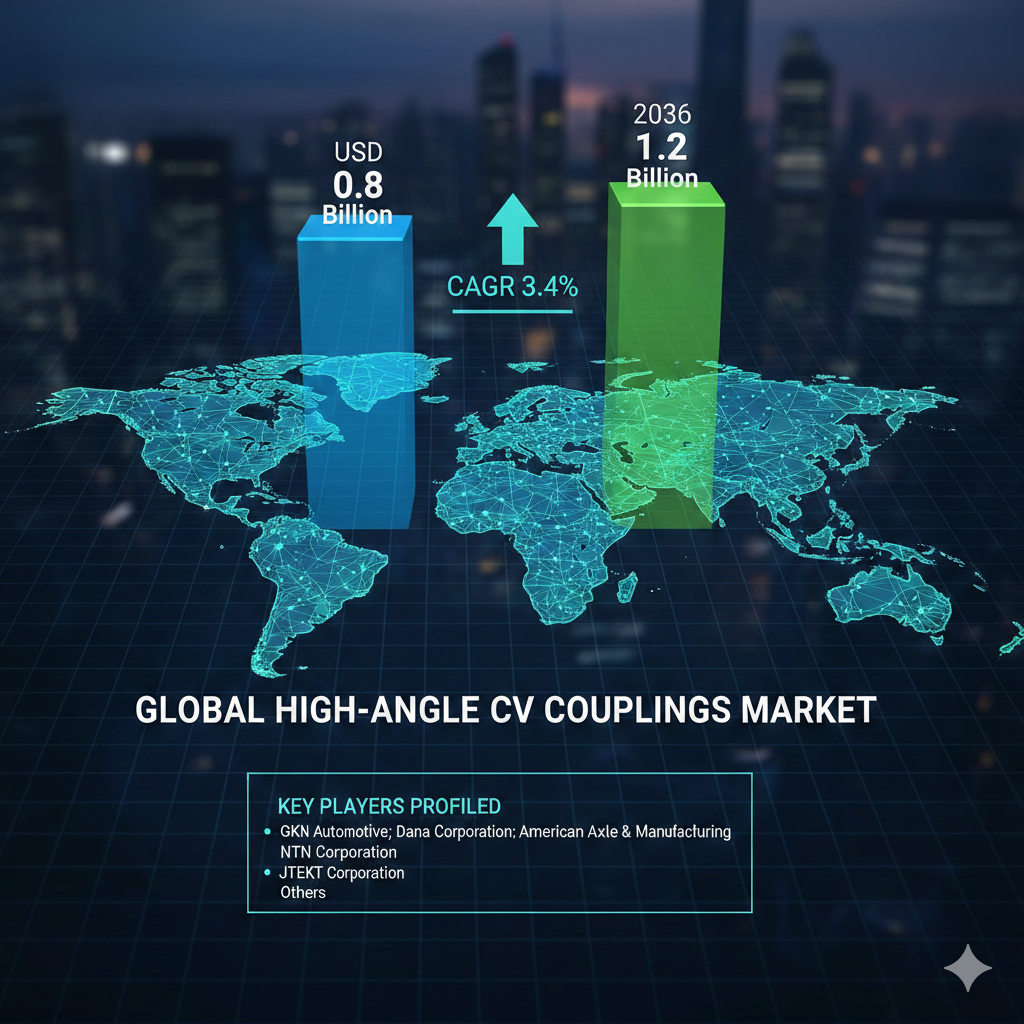
NEWARK, DE, UNITED STATES, February 16, 2026 /EINPresswire.com/ -- The global high-angle CV couplings market is projected to reach USD 0.8 billion in 2026 and expand to USD 1.2 billion by 2036, advancing at a CAGR of 3.4%. The steady growth trajectory reflects the automotive industry’s shift toward precision-engineered drivetrain systems designed to meet evolving angular flexibility and torque control requirements.
As vehicle architectures become increasingly complex—particularly across SUVs, pickup trucks, crossovers, and electrified platforms—traditional joint systems are rapidly evolving into multi-functional coupling solutions. Manufacturers are prioritizing controlled torque delivery, reduced vibration, and extended service cycles, positioning high-angle CV couplings as a strategic component of modern drivetrain platforms.
Request For Sample Report | Customize Report | Purchase Full Report - https://www.futuremarketinsights.com/reports/sample/rep-gb-32018
Market Outlook and Value Analysis
Industry analysis indicates that the high-angle CV couplings market will grow from USD 0.8 billion in 2026 to USD 1.2 billion by 2036, supported by consistent global automotive production expansion and drivetrain technology upgrades. The projected CAGR of 3.4% reflects steady adoption across both internal combustion engine (ICE) and electrified vehicle platforms.
Forecast modeling incorporates:
• Automotive production trends
• All-wheel-drive (AWD) system penetration rates
• Electric vehicle integration analysis
• Component-level performance validation studies
The market includes Rzeppa high-angle joints, tripod high-angle joints, double cardan CV joints, and other specialized coupling systems designed for enhanced angular transmission across SUVs, pickups, crossovers, and commercial vehicles.
Precision Engineering Driving Transformation
High-angle CV couplings are no longer viewed as basic mechanical connectors. Advanced materials engineering, enhanced bearing mechanisms, and improved lubrication retention systems now enable:
• Superior angular flexibility
• Controlled torque consistency
• Reduced drivetrain vibration
• Extended lifecycle durability
This evolution directly addresses automakers’ priorities around efficiency, noise reduction, compliance, and long-term reliability.
Demand Accelerators Across Vehicle Segments
SUV applications dominate the market, accounting for 46% of total share, driven by AWD standardization and traction control requirements. Pickup trucks and crossover vehicles follow closely, particularly in markets where performance and off-road capability influence purchasing decisions.
The key demand drivers include:
• Expansion of AWD platforms across passenger vehicles
• Increasing electrification of drivetrains
• Growth in heavy-duty pickup production
• Consumer demand for improved traction and performance
Electric vehicle compatibility is emerging as a decisive growth factor. As motor configurations and battery placement alter drivetrain geometry, high-angle CV couplings are being redesigned to optimize torque transfer under electric load profiles.
Joint Design Leadership: Rzeppa at the Forefront
By joint design, Rzeppa high-angle joints command 44% of market share. Their ability to maintain torque stability across wide angular ranges makes them essential in SUV and performance vehicle applications.
Tripod high-angle joints remain critical for compact packaging and cost-efficient assembly environments. Meanwhile, double cardan CV configurations serve commercial vehicles and heavy-duty applications requiring enhanced torque capacity and durability under stress-intensive conditions.
Regional Performance Highlights
The United States maintains the largest value share, supported by strong SUV and pickup truck production. Meanwhile, China is projected to grow at the fastest rate, with a 4.7% CAGR through 2035, driven by EV manufacturing expansion and rising middle-class vehicle ownership.
Other notable growth projections include:
• United States: 3.2% CAGR
• Germany: 2.9% CAGR
• Brazil: 4.5% CAGR
• South Korea: 2.9% CAGR
Growth across these regions is driven more by drivetrain sophistication and performance optimization than by sheer production volume.
Competitive Landscape and Strategic Developments
The competitive environment remains concentrated among established automotive drivetrain specialists such as:
• GKN Automotive
• Dana Incorporated
• American Axle & Manufacturing
• NTN Corporation
• JTEKT Corporation
• Schaeffler Group
• Nexteer Automotive
• Hyundai WIA Corporation
• ZF Friedrichshafen
These companies are investing heavily in advanced materials science, EV-compatible joint systems, and automated precision manufacturing. Strategic partnerships and portfolio expansions are reinforcing their ability to deliver comprehensive drivetrain solutions rather than standalone components.
Technological Evolution Reshaping the Sector
The sector is transitioning from traditional universal joint solutions toward integrated coupling platforms that combine angular stabilization, torque optimization, and durability enhancement. Enhanced validation protocols and simulation-based testing are ensuring predictable angular control and consistent torque transmission.
Improved coupling architecture reduces drivetrain noise and enhances operational smoothness—critical factors in both luxury and electric vehicles where cabin refinement is a priority.
Frequently Asked Questions (FAQs)
What is driving the high-angle CV couplings market?
SUV expansion, AWD standardization, EV integration, and demand for enhanced angular performance are key growth drivers.
Which segment dominates the market?
SUV applications lead with 46% share, while Rzeppa high-angle joints dominate joint design with 44%.
Which country shows the fastest growth?
China leads with a projected 4.7% CAGR through 2036.
Are EVs impacting demand?
Yes. Electric drivetrain layouts require precision coupling systems optimized for electric torque characteristics.
What is the long-term outlook?
The market demonstrates stable mid-single-digit growth supported by drivetrain technology advancements and electrification momentum.
Browse Related Insights
CV Depot Charging Market: https://www.futuremarketinsights.com/reports/cv-depot-charging-market
HCV Suspension System Market: https://www.futuremarketinsights.com/reports/hcv-suspension-system-market
CV Joints and Constant Velocity Couplings Market: https://www.futuremarketinsights.com/reports/cv-joints-and-constant-velocity-couplings-market
About Future Market Insights (FMI)
Future Market Insights, Inc. (FMI) is an ESOMAR-certified, ISO 9001:2015 market research and consulting organization trusted by Fortune 500 clients and global enterprises. With operations in the U.S., UK, India, and Dubai, FMI provides data-backed insights and strategic intelligence across 30+ industries and 1200 markets worldwide.
Sudip Saha
Future Market Insights Inc.
+18455795705 ext.
email us here
Legal Disclaimer:
EIN Presswire provides this news content "as is" without warranty of any kind. We do not accept any responsibility or liability for the accuracy, content, images, videos, licenses, completeness, legality, or reliability of the information contained in this article. If you have any complaints or copyright issues related to this article, kindly contact the author above.
